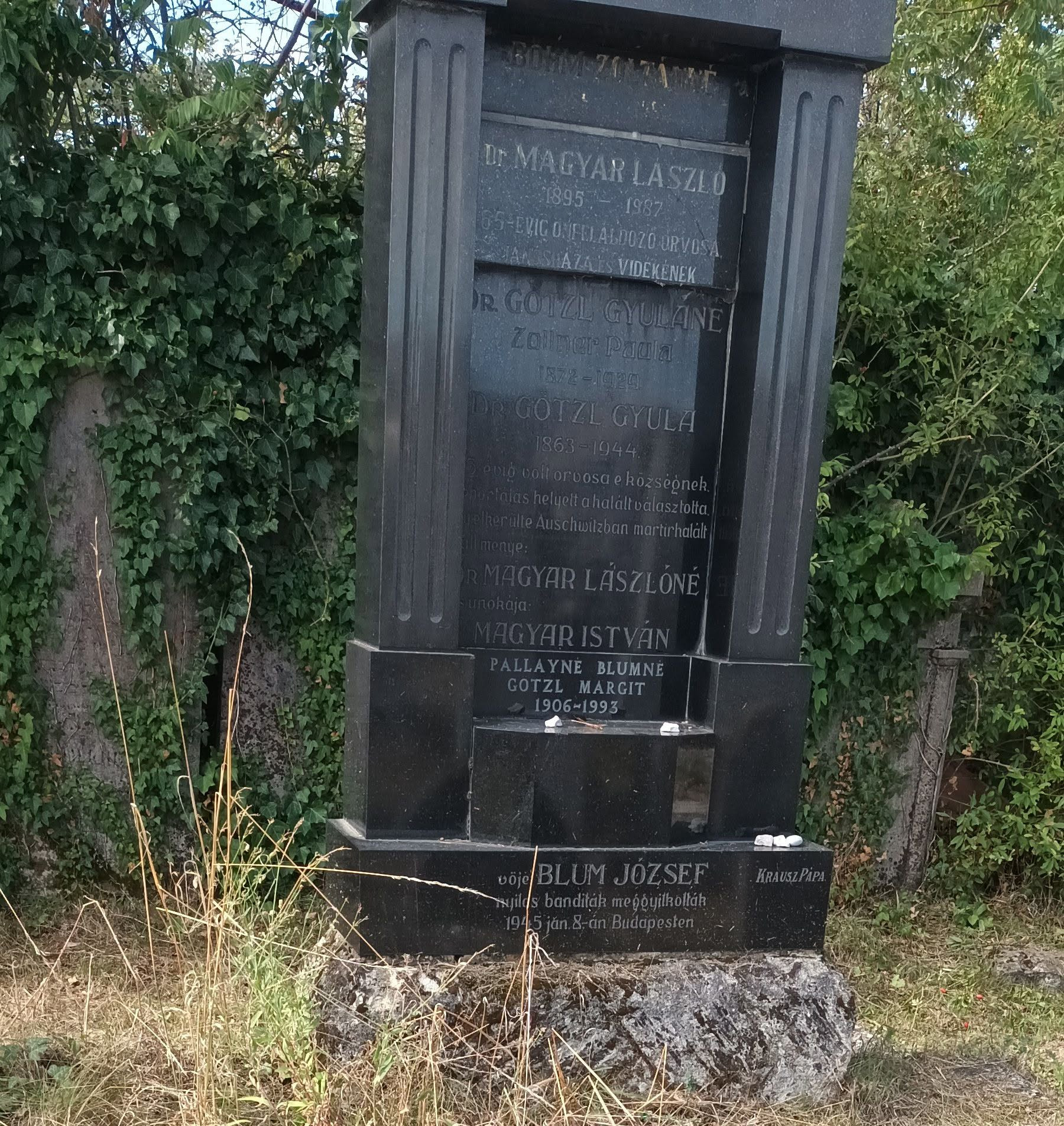
A photo uploaded to Facebook sparked a genealogical investigation, shedding light on the story of a Jewish family. Indeed, that photograph served as the starting point for tracing the ancestors and descendants of Dr. László Magyar, a former physician in Jánosháza. The research eventually expanded to include the late, popular doctor’s extended family—bringing me face-to-face with the most horrific tragedy of the 20th century.
Zsuzsanna Balogh uploaded a picture to a Jánosháza Facebook group showing the memorial monument of Dr. László Magyar’s family in the local Jewish cemetery. The monument bears the names of László Magyar’s parents, the doctor himself, his wife and son, and his younger sister, Margit; the name of Margit’s first husband is also inscribed at the base of the stone. However, the remains of several individuals named on the monument do not rest there.
By way of introduction, a note on the challenges of researching Jewish families: the official registration of Jewish vital statistics was only mandated by an imperial decree in 1851, making it difficult to find consistent data from the period prior to that. Consequently, tracing the ancestry of Jewish families is limited in scope and cannot go back very far in time. Another major disruption in the research process is the Holocaust, during which many family members were murdered or perished while in forced labor service; documentation regarding these events is often incomplete.
Dr. László Magyar’s family were respected members of the Jewish community in Jánosháza. A Jewish community lived in the town (now a small town) as early as the 18th century. This community experienced its heyday in the second half of the 19th century; its members were typically merchants, artisans, and factory or mill owners. The congregation flourished, even maintaining a yeshiva (a school for the study of the Torah, the Talmud, and Jewish law). From the early 20th century onwards, the town—and consequently its Jewish merchants—faced increasing difficulties; as Jánosháza fell out of the mainstream of trade, emigration occurred, primarily to Szombathely.
Dr. László Magyar was originally named László Götzl; he changed his name in 1910. His father, Dr. Gyula Götzl, was a physician who treated patients in Jánosháza and the surrounding area for 50 years. His mother was Paula Zollner. Gyula Götzl’s parents were Zsigmond Götzl (also known as Salamon), born in Nagymarton (now Mattersdorf, Austria), and Julianna Kohn. Zsigmond Götzl’s parents, Joachim Götzl and Sára Bauer, came from Vienna. Paula Zollner’s parents were Ferenc Zollner (son of Juda Zollner) and Háni Hirschfeld (daughter of Dávid Hirschler and Terézia Altstäter).
Given that researching only the direct ancestors and descendants of Dr. László Magyar would have yielded a rather sparse family tree, I extended the research to include collateral relatives as well. This revealed an interesting picture that also offers insight into the life of Jewish society in the 19th and 20th centuries. Several family members changed their surnames, and there was even one who converted to Christianity.
The couple Zsigmond Götzl and Julianna Kohn had twelve children, eleven of whom reached adulthood—and six of whom certainly fell victim to the Holocaust. Dr. Gyula Götzl had four children: one died in infancy, one daughter perished in a death camp, the husband of another daughter was shot dead by the Arrow Cross, and Gyula Götzl himself committed suicide to escape deportation on the day the move to the ghetto began.
The couple Ferenc Zollner and Háni Hirschfeld raised eight children, two of whom certainly met their end in a death camp.
It is truly shocking that twenty-two members of the extended family (siblings, cousins, second cousins, along with their spouses and children) certainly fell victim to that senseless terror!
Dr. László Magyar had a single son; the last record concerning him indicates that he was loaded onto a transport train in Szombathely. He does not appear in any subsequent records that list either the victims or the survivors. His wife, Erzsébet Berger—a native of Macal—shared the same fate.
Research of this kind gives one pause for thought. Although the data uncovered is stark—showing only the life events of specific individuals—I shudder when I look at the years 1944 and 1945 in the “date of death” column. We all learned about the horrors of the Holocaust in school, of course, but it is a completely different experience to be repeatedly confronted—while tracing a family tree—with the fact that the person being researched was murdered in the name of a deranged ideology, and that these murders were carried out on an industrial scale.
I urge those who have read this far to pause for a moment and consider the consequences when politics incites the masses to hatred against others. Let us ensure that such a mass tragedy never happens again.
Clicking the image below allows you to view the family tree of the relatives of Dr. László Magyar. While the image can be viewed on a mobile phone, it is easier to examine in detail on a computer screen. You can read more about Jewish genealogy here.